Custom Peptides
Gip Peptide has years of expertise
Quotes for larger research product orders
Custom Peptides
Gip Peptide has years of expertise
Price range: $50.00 through $120.00

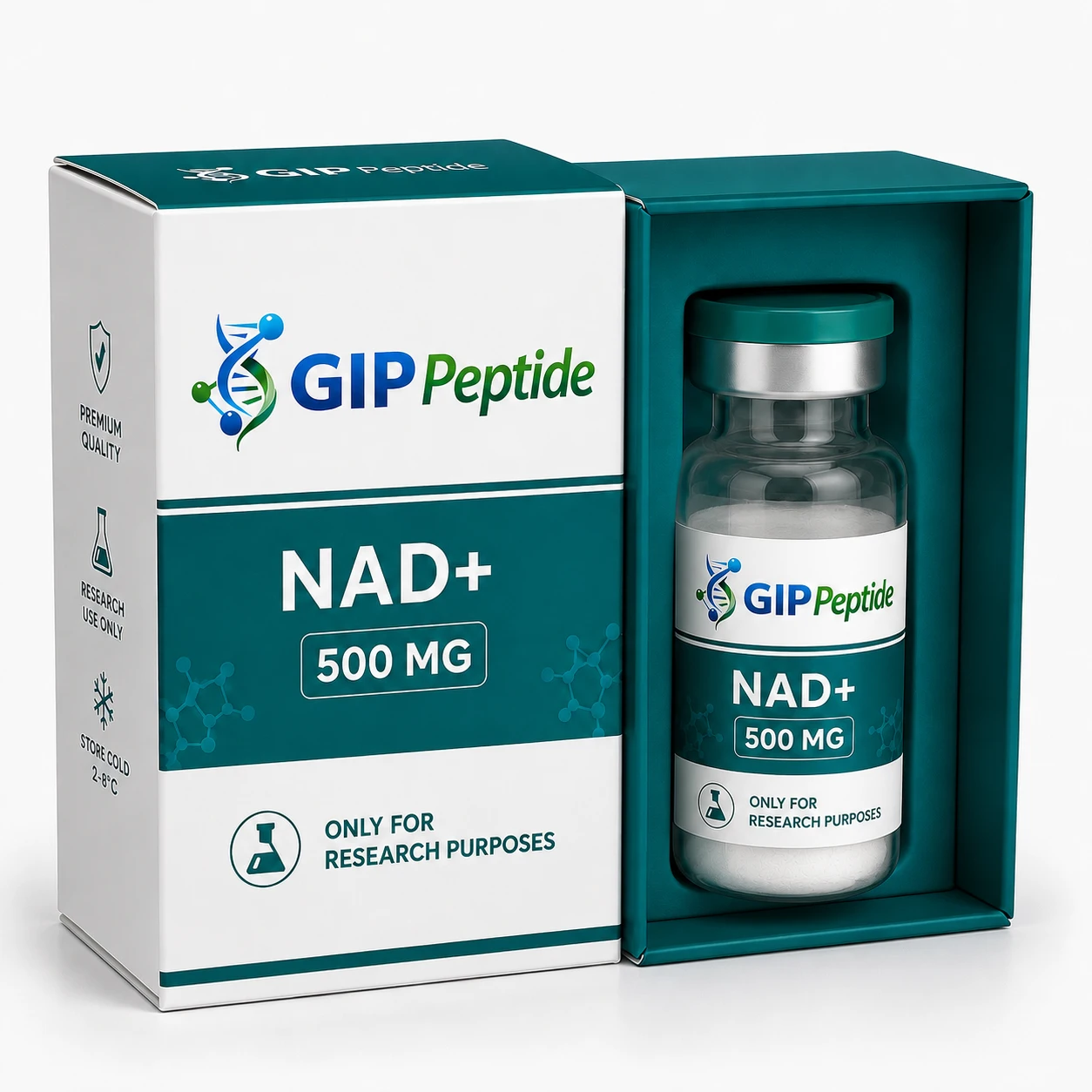
NAD+ 500mg is a research-grade coenzyme supplied as a lyophilized powder for laboratory and scientific investigation. Nicotinamide adenine dinucleotide (NAD+) plays a central role in cellular energy production and metabolic function, making it an important subject in aging, mitochondrial, and cellular biology research.
NAD+ is a naturally occurring coenzyme present in living cells where it supports numerous biological processes, including energy metabolism and cellular signaling. Researchers continue to investigate its role in mitochondrial function, healthy aging, oxidative stress, and DNA repair.
| Specification | Details |
| Product | NAD+ 500mg |
| Form | Lyophilized powder |
| Quantity | 500mg per vial |
| Appearance | White to off-white powder |
| Container | Sterile glass vial |
| Intended Use | Research purposes only |
Proper NAD 500 mg reconstitution helps preserve the stability of the research material before experimental use.
General laboratory preparation typically includes:
Researchers preparing to reconstitute NAD+ 500mg should use sterile equipment and appropriate laboratory techniques throughout the preparation process.
General recommendations include:
Proper preparation supports consistency across laboratory studies.
Preparation practices generally include:
Before Reconstitution
There is no universally accepted dosing protocol for research involving NAD+ because study designs differ depending on research objectives.
Researchers typically establish protocols based on:
All research should follow approved scientific procedures.
A NAD+ dosage calculator is commonly used during laboratory preparation to determine the concentration of a reconstituted solution.
Researchers generally calculate:
Calculations should always be verified before beginning laboratory work to ensure accuracy and consistency.
Researchers may also work with a NAD 1000 mg vial when larger quantities are required for extended studies or higher-volume laboratory projects.
Although the preparation process is similar, the amount of diluent added will differ depending on the desired concentration. The selected concentration should always match the objectives of the study and follow the approved research protocol.
Research frequently examines NAD and glutathione supplements because both compounds are associated with cellular metabolism and antioxidant systems.
Current laboratory investigations explore how these compounds may influence:
These areas remain active fields of scientific research and continue to evolve as additional evidence becomes available.
Interest in NAD and menopause has increased as researchers investigate the relationship between cellular aging, hormonal changes, and metabolic health.
Current research explores potential biological mechanisms rather than established clinical outcomes. Additional human studies are needed to better understand any possible relationship.
NAD+ continues to be studied across multiple scientific disciplines.
Common areas of investigation include:
Most findings originate from laboratory and preclinical research.
Published research involving NAD+ commonly focuses on:
Researchers should evaluate peer-reviewed literature when designing experimental studies.
Well-designed laboratory studies often include:
Careful planning improves the reliability and reproducibility of research findings.
Depending on research objectives, NAD+ may be studied alongside other laboratory compounds such as:
Combination studies should always follow approved laboratory protocols.
Each production batch should undergo quality assessment before release for research use.
A Certificate of Analysis (COA) documents important quality characteristics, including product identity and analytical testing results.
Quality control procedures commonly include:
These evaluations help confirm product consistency for laboratory research.
Published information regarding NAD+ primarily comes from research settings and clinical investigations.
Reported observations vary depending on administration methods and study design.
Research involving NAD+ injection side effects has reported observations such as:
Reported observations differ between studies and should not be interpreted as complete safety information.
Information regarding NAD+ side effects injection continues to develop as additional clinical and laboratory research becomes available.
Researchers should carefully document all observations, follow approved study protocols, and evaluate findings within the context of each investigation.
Researchers should:
NAD+ 500mg is supplied exclusively for laboratory research.
It is not intended:
All research should comply with applicable institutional and regulatory requirements.
Published information regarding interactions between NAD+ and other research compounds remains limited.
Researchers should carefully evaluate potential interactions before conducting combination studies and document all experimental variables.
General laboratory handling recommendations include:
NAD+ 500mg is supplied solely for laboratory research purposes.
This product is not approved as a drug, food, cosmetic, or dietary supplement. It is not intended to diagnose, treat, cure, or prevent any disease. Researchers are responsible for following all applicable laws, regulations, and institutional policies governing the handling and use of research materials.
| SELECT MG | 500 MG, 1000 MG |
|---|
Anti-Aging & Longevity

All GIP PEPTIDE
 Price range: $50.00 through $120.00



Reviews
There are no reviews yet.