Custom Peptides
Gip Peptide has years of expertise
Quotes for larger research product orders
Custom Peptides
Gip Peptide has years of expertise
$40.00

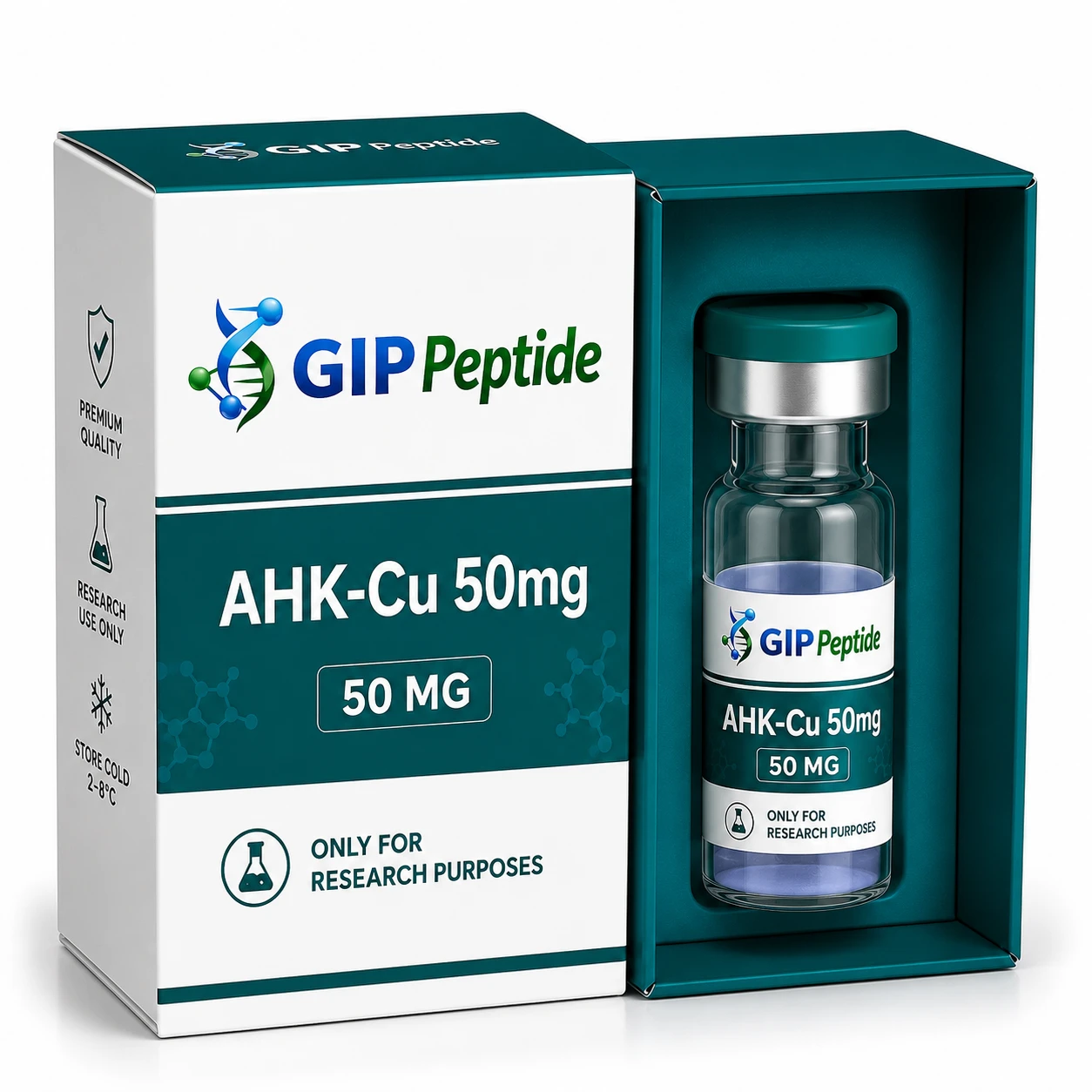
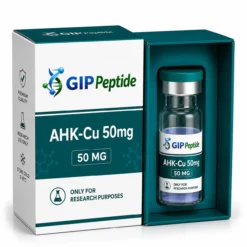
In cellular bioenergetics and hair follicle biology research, specialized copper complex peptides are widely evaluated for their role in follicular proliferation and extracellular matrix synthesis. The ahk cu copper tripeptide complex represents a targeted copper-binding peptide engineered to evaluate dermal papilla cell growth and skin tissue health in controlled laboratory environments.
By delivering bioavailable copper directly to dermal cells, the peptide ahk cu sequence provides researchers with a refined molecular tool to study cellular signaling, microvascular development around hair follicles, and collagen production.
| Attribute | Specification Details |
| Form | Lyophilized (freeze-dried) powder |
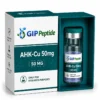
| Vial Capacity | 50mg total mass |
| Sequence / Class | Ala-His-Lys-Cu (Amino acid copper complex) |
| Purity Standard | \ge 98\% purity standard |
| Physical Appearance | Solid cake with a characteristic light blue tint |
When researchers examine what is ahk cu, literature defines it as Ala-His-Lys Copper Tripeptide-1. It is a synthetic tripeptide consisting of alanine, histidine, and lysine complexed with a copper (II) ion. This specific amino acid sequence exhibits high affinity for hair follicle dermal papilla cells, where it regulates apoptotic pathways and stimulates cell proliferation.
Both GHK-Cu and AHK-Cu are copper-binding tripeptides, yet scientific literature distinguishes their primary physiological targets:
Understanding the difference in ghk cu vs ahk cu enables research teams to select the optimal peptide depending on whether the primary trial objective is hair follicle biology or broad dermal wound healing.
In non-clinical topical research models, investigators often incorporate reconstituted AHK-Cu into specialized vehicle solutions. Discussions regarding an ahk cu hair serum recipe or an experimental ahk cu serum focus on maintaining optimal pH levels (typically 5.5 to 6.5) and avoiding strong oxidizing or acidic ingredients that could detach the copper ion from the peptide chain.
Note on Research Vectors: While preclinical studies investigate both topical applications and ahk cu injection protocols in animal models, standardized liquid vehicles are strictly formulated to maintain complex stability across variable assay environments.
In multi-pathway follicular and skin research designs, AHK-Cu is frequently paired with complementary research agents, including:
Compliance Notice: AHK-Cu 50mg is designated strictly for laboratory research, in vitro testing, and non-clinical scientific evaluation. It is not approved for human consumption, direct medical treatment, or clinical diagnostic use.
Copper tripeptides are sensitive to drastic pH shifts, ultraviolet light, thermal fluctuations, and strong chelating agents. Exposure to acidic conditions can cause copper ions to dissociate from the amino acid backbone, rendering the compound ineffective. Handle containers with care.
To reconstitute a 50mg vial of AHK-Cu in a laboratory setting, follow this standardized sequence:
Data drawn from preclinical and cellular models indicate a favorable safety profile:
Research protocols incorporating AHK-Cu should exclude experimental setups displaying:
Mixing AHK-Cu directly in solution with strong chelating agents (such as EDTA) or ascorbic acid will strip the bound copper ion from the tripeptide. Always test compatibility in small assay volumes before combining AHK-Cu with other active compounds in a single vehicle.
Certificate of Analysis (COA)
To guarantee experimental accuracy and batch consistency, every lot of AHK-Cu 50mg must undergo analytical verification by an independent, third-party laboratory. A compliant COA verifies:
Prior to introducing a new batch into an active research protocol, complete the following quality checks:
Anti-Aging & Longevity

All GIP PEPTIDE



Reviews
There are no reviews yet.