Custom Peptides
Gip Peptide has years of expertise

Quotes for larger research product orders
Custom Peptides
Gip Peptide has years of expertise
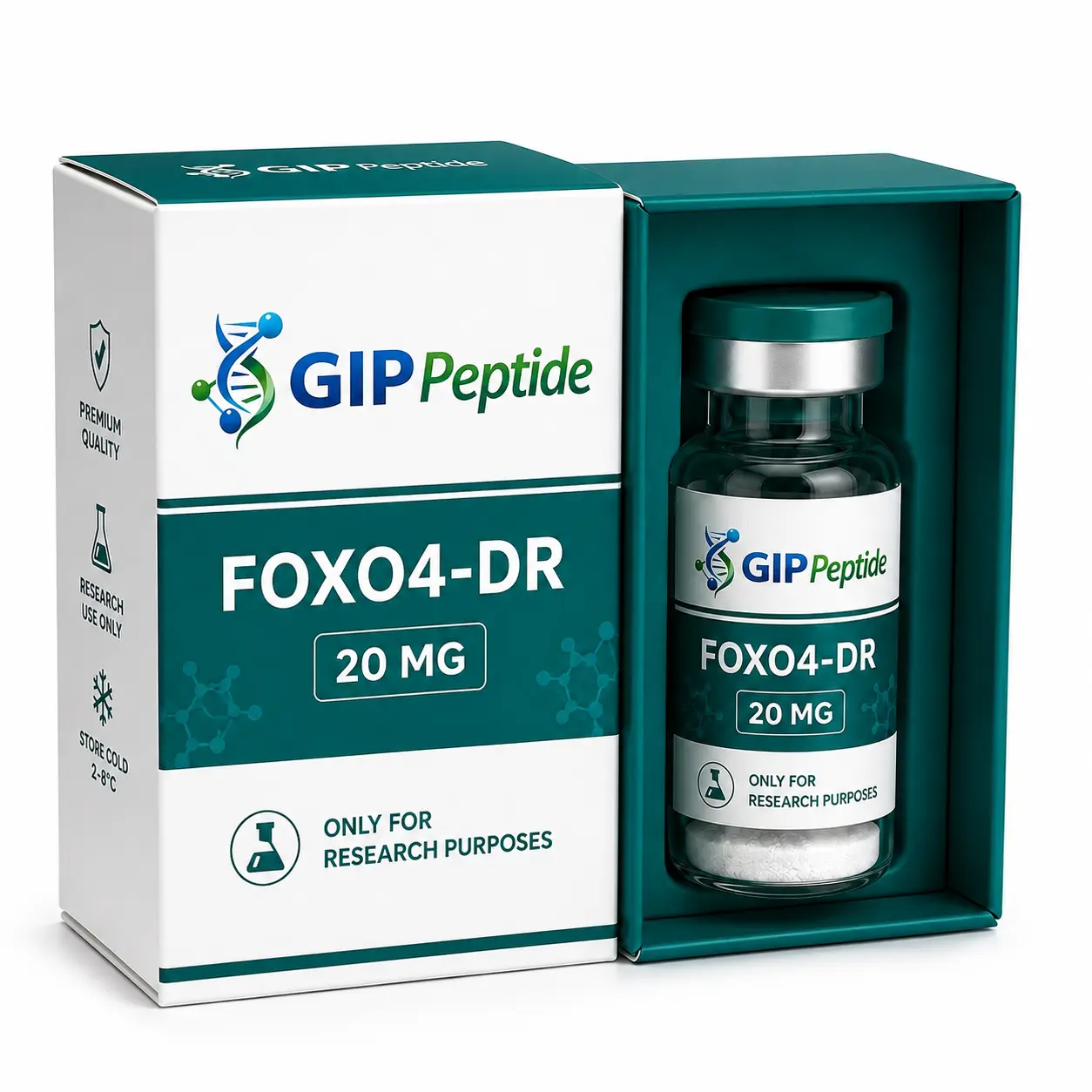
$75.00
| Quantity | Discount | Discounted price |
| 2 | 5% | $71.25 |
| 3 | 10% | $67.50 |
| 4 | 15% | $63.75 |
| 5 - 7 | 20% | $60.00 |
| 8 - 50 | 25% | $56.25 |
| 51 - 100 | 30% | $52.50 |


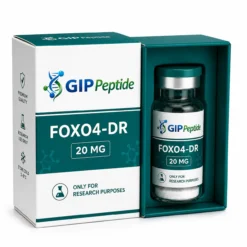
FOXO4-DRI is a synthetic, research-use peptide designed to interrogate a specific survival pathway in senescent cells. In published preclinical work, the concept centers on disrupting the interaction between the transcription factor FOXO4 and the tumor suppressor protein p53. Senescent cells can resist apoptosis despite extensive cellular damage, and the FOXO4–p53 axis has been described as one mechanism that helps maintain that survival state. FOXO4-DRI was engineered as a “decoy” strategy: by interfering with FOXO4’s ability to sequester or regulate p53 in senescent cells, the pathway may be shifted toward p53-mediated apoptosis. For researchers, the peptide’s appeal is its tractable, testable hypothesis: a defined protein–protein interaction target linked to senescent cell persistence.
FOXO4-DRI drew broad attention because reported preclinical findings suggested selective vulnerability of senescent cells compared with non-senescent counterparts, alongside functional readouts relevant to aging biology. In the referenced research context, senescent cell clearance was associated with improvements in certain tissue and health parameters in animal models, supporting the broader senolytic thesis that selectively reducing senescent burden can modulate age-related phenotypes. Importantly, these are research findings rather than clinical claims. Nevertheless, the work remains influential because it offers a mechanistically anchored tool for studying senescence, p53 signaling dynamics, and the downstream consequences of senescent cell removal in controlled experimental settings.
In senescence, p53 activity is tightly regulated, and senescent cells may rely on protective signaling networks to avoid apoptosis. FOXO4 has been implicated in maintaining viability in these cells by modulating p53 localization and activity. FOXO4-DRI is designed to disrupt that dependency. From a research perspective, this enables carefully constructed experiments that compare senescent versus proliferating cells, quantify apoptosis markers, and map transcriptional or proteomic changes following treatment. Because the proposed mechanism is comparatively specific, FOXO4-DRI can serve as a precision probe: not merely “killing cells,” but testing whether FOXO4–p53 interaction integrity is a functional requirement for senescent cell persistence under defined conditions.
Positioning FOXO4-DRI as a premium research peptide is justified when it is delivered with the documentation and quality attributes demanded by serious senescence programs: lot-to-lot consistency, transparent analytical characterization, and handling guidance that preserves integrity across storage and experimental workflows. A premium positioning also reflects the peptide’s role in high-impact, hypothesis-driven studies where data quality depends on reagent reliability. In this context, FOXO4-DRI is best framed as a specialized tool for advanced users—laboratories running senescence models, apoptosis assays, and mechanistic pathway studies that require confidence in identity, purity, and reproducibility.
Evaluating FOXO4-DRI as a research-use peptide should be treated as a quality systems exercise rather than a purchasing checkbox. At minimum, assess whether the supplier provides clear analytical confirmation of peptide identity (such as mass spectrometry) and purity (commonly high-performance liquid chromatography). For demanding studies, you will also want traceable documentation tied to the specific lot you receive, not generic example reports. If your experimental design is sensitive to aggregation, oxidation, or degradation, prioritize vendors who disclose storage recommendations, reconstitution solvents, and short-term handling limits. A premium FOXO4-DRI offering should make it easy to defend your reagent choice during peer review, internal audits, or collaborative data sharing.
Peptides can be vulnerable to repeated freeze–thaw cycles, moisture uptake, and solution instability. To preserve performance, researchers commonly aliquot upon initial reconstitution, minimize time at room temperature, and store under conditions aligned with supplier guidance. Solvent choice can materially affect solubility and experimental outcomes, so it is prudent to validate reconstitution and dilution steps in your specific assay matrix. Treat FOXO4-DRI as a precision reagent: consistent preparation practices are part of experimental rigor, especially when comparing senescent and non-senescent populations where subtle shifts in effective concentration can distort interpretation.
FOXO4-DRI is particularly well suited to study designs that connect mechanistic disruption to biological outcomes. Examples include comparing response profiles across senescence induction methods, quantifying apoptosis and viability shifts, and assessing downstream markers linked to senescence-associated signaling. It can also support combination or sequencing studies when researchers want to distinguish pathway-specific effects from general cytotoxicity. Because senescence is heterogeneous, rigorous controls are essential: cell state verification, dose-ranging, time-course mapping, and orthogonal readouts strengthen conclusions. In premium research workflows, FOXO4-DRI is used not as a standalone “answer,” but as a definitive perturbation that clarifies causal relationships.
FOXO4-DRI should be positioned strictly for research use. Published findings in model systems are valuable for hypothesis generation and experimental exploration, but they do not establish clinical safety, efficacy, or suitability for human or veterinary applications. A professionally positioned FOXO4-DRI 20mg product description should be explicit about these boundaries while still highlighting why the reagent matters: it provides a direct, mechanistically meaningful way to test how FOXO4–p53 signaling contributes to senescent cell survival and what happens when that support is removed in controlled experimental systems.
Anti-Aging & Longevity

All GIP PEPTIDE
| Quantity | Discount | Discounted price |
| 2 | 5% | $71.25 |
| 3 | 10% | $67.50 |
| 4 | 15% | $63.75 |
| 5 - 7 | 20% | $60.00 |
| 8 - 50 | 25% | $56.25 |
| 51 - 100 | 30% | $52.50 |



Reviews
There are no reviews yet.