Custom Peptides
Gip Peptide has years of expertise

Quotes for larger research product orders
Custom Peptides
Gip Peptide has years of expertise
Price range: $120.00 through $299.99

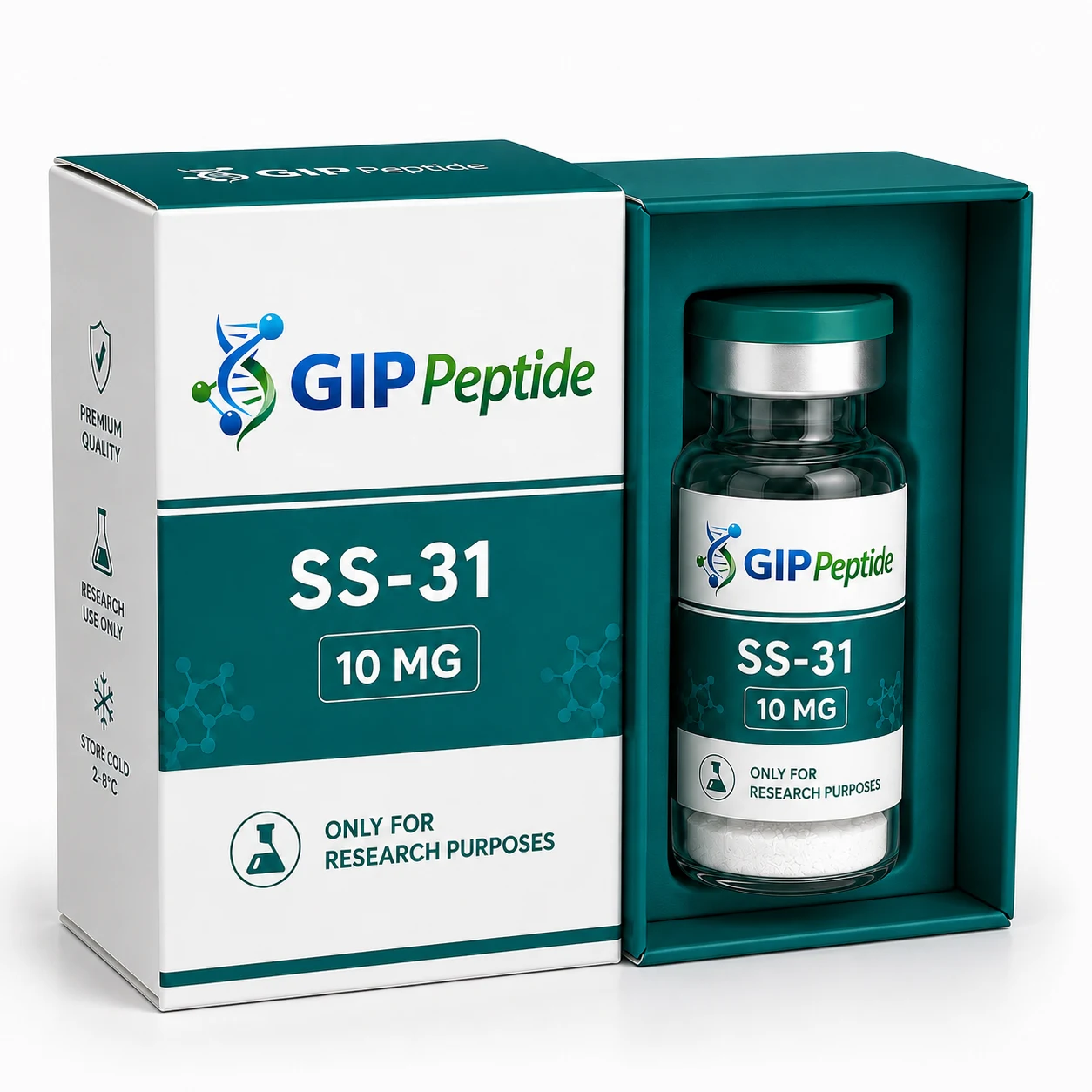
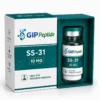
In cellular energetic and bioenergetic research, mitochondrial-targeted peptides represent a pivotal area of investigation. The ss-31 10mg reconstitution process and research framework center around Elamipretide (SS-31), a specialized synthetic tetrapeptide engineered to selectively target the inner mitochondrial membrane.
Unlike non-targeted antioxidants, ss 31 peptides interact directly with cardiolipin, a crucial phospholipid residing in the inner mitochondrial membrane. By stabilizing cardiolipin, SS-31 helps preserve cristae structure, optimize electron transport chain efficiency, and reduce excessive reactive oxygen species (ROS) production at the cellular source.
| Attribute | Specification Details |
| Form | Lyophilized (freeze-dried) powder |
| Vial Capacity | 10mg total mass (also evaluated in larger ss 31 50mg formats) |
| Target Mechanism | Inner mitochondrial membrane / Cardiolipin binding |
| Purity Standard | High purity benchmark (\ge 98\%) |
| Physical Appearance | Solid, uniform white cake |
In scientific literature, research on SS-31 focuses heavily on mitochondrial dysfunctions associated with aging, ischemia-reperfusion injury, cardiorenal syndromes, and metabolic decline. By preventing cardiolipin oxidation, SS-31 restores ATP synthesis capacity without altering baseline signaling pathways.
While both compounds fall under mitochondrial research frameworks, their primary mechanisms of action differ fundamentally:
Understanding the distinction between mots-c vs ss-31 allows researchers to isolate structural membrane stabilization from broader systemic metabolic signaling.
In advanced longevity and bioenergetic study designs, researchers frequently examine a mots-c ss-31 stack. Combining these agents allows for a dual-action approach: evaluating direct organelle structural protection through SS-31 alongside metabolic signaling activation via MOTS-c. Studies exploring ss31 and mots-c combinations provide valuable insights into synergistic cellular recovery.
While 10mg vials serve as an ideal baseline for initial dilution and smaller sample groups, high-throughput laboratories often utilize larger capacities such as the ss 31 50mg variant to maintain batch consistency across extended, multi-subject longitudinal trials.
Compliance Notice: SS-31 is strictly designated for laboratory research, in vitro testing, and non-clinical scientific evaluation. It is not approved for human consumption, direct medical treatment, or clinical diagnostic use.
A standardized ss31 peptide protocol in laboratory settings depends on precise liquid calculations during preparation. Maintaining correct concentration parameters ensures reproducible baseline data across experimental models.
Peptides consist of delicate amino acid sequences held together by precise biological bonds. Physical trauma, rapid thermal changes, or aggressive shaking can cause protein shearing or denaturation, leading to loss of activity. Always handle containers with care.
To properly reconstitute ss-31 10mg lyophilized powder, follow this controlled laboratory protocol:
Storage Requirements
Safety Observations
Data drawn from preclinical studies and clinical trials highlight a favorable safety profile characterized by low systemic toxicity:
Research models involving SS-31 should exclude experimental setups displaying:
Co-administering SS-31 alongside other mitochondrial agents or metabolic regulators requires baseline tracking. Combining the compound with unmonitored enzymatic inhibitors should be executed with proper controls to maintain clear trial baselines.
To guarantee experimental integrity and batch consistency, every lot of SS-31 must be validated by an independent, third-party laboratory. A fully compliant COA verifies:
Quality Inspection Checklist
Prior to introducing a new reconstituted batch into an active research sequence, confirm the following parameters:
| SELECT MG | 10 MG, 20 MG, 30 MG |
|---|
Anti-Aging & Longevity

All GIP PEPTIDE
 Price range: $120.00 through $299.99



Reviews
There are no reviews yet.